The National Tree Safety Group records fewer than five deaths a year in the UK from falling trees or branches – around three of those in public spaces. That’s against roughly 1,700 killed on the roads each year, which is why the risk sits in what safety guidance calls the “broadly acceptable” band.
Most trees are far safer than they look. A trunk that’s leaned a little further since the last storm, a branch on the lawn, a letter from the council about the lime out front – none of it means the tree is about to come down.
But if a tree on your property has you uneasy, you can get a tree risk assessment to see if it’s truly dangerous or fine as is.
We’re Forbes Tree Care, arborists working across North London since 2010. Checking whether a tree is safe is everyday work for us, so we’ve outlined exactly what that involves.
Tree risk assessment at a glance
- A tree risk assessment is a safety check by a qualified arborist that judges how likely a tree is to fail and what it would hit if it did – the two halves that together define real risk.
- A tree risk assessment is different from a tree survey: a survey is usually for planning or a mortgage, while an assessment is purely about safety.
- You likely need a tree risk assessment if a tree looks unstable, shows rot, fungus or deadwood, has already dropped a branch, or a neighbour or council has flagged it.
- For most domestic trees it’s a same-day, ground-level visual inspection ending in a short, plain-English report – not weeks of work.
- The legal duty on tree owners is real but proportionate: you must act reasonably, not inspect every tree constantly.
What a tree risk assessment actually is
A tree risk assessment is a qualified arborist’s inspection that judges how likely a tree is to fail, what it could damage or injure if it did, and what – if anything – needs to be done about it.
They are necessary because trees are living, shifting structures. They decay, lean, shed limbs, and respond to storms and root disturbance – and yesterday’s healthy tree is not guaranteed to be today’s. The assessment is how a professional reads those changes and tells you where the tree actually stands.
“Risk” here isn’t simply “is the tree damaged?” It’s the product of three things:
- How likely a part is to fail,
- How big that part is, and
- What sits beneath it.
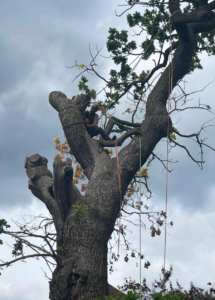
The recognised UK standard, Quantified Tree Risk Assessment (QTRA), assesses exactly these three components and combines them to quantify the risk of harm, which is the method our team is trained in.
The difference between tree risk assessments and tree surveys
A tree risk assessment asks whether a tree is safe, while a tree survey records what’s there and what constrains it – usually for planning or a property deal.
Both terms get used interchangeably often enough that people regularly book the wrong one. There are three dimensions on which they differ:
- Purpose: A risk assessment answers one question: is this tree safe? A survey answers a broader one: what’s here, what condition is it in, and what restricts work or building near it?
- Trigger: You get an assessment because something has you worried about safety. You get a survey because a process demands it – a BS5837 survey for a planning application, a mortgage report, or an insurance report.
- Output: An assessment gives you a safety verdict and a list of recommended actions. A survey gives you a formal document written to be read and accepted by a third party: a council, a lender, or an insurer.
We offer both services. If you need a planning, mortgage, or insurance report, check that out here.
When your tree needs a risk assessment
Most tree risk assessments are prompted by one of four things: a visible defect, a recent event, an outside party raising a concern, or a change in who’s responsible. Almost nobody books one as routine. Something specific tips them into calling, and these are what we’re called out for most.
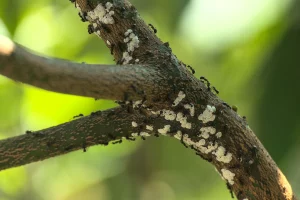
- Visible warning signs: large dead or hanging branches, cracks in the trunk or a major limb, fungus at the base, or surface roots lifting a path or driveway.
- A recent event: a branch has come down, the tree has leaned further since the last storm, or nearby ground works have disturbed the roots.
- Someone else has flagged it: a neighbour, tenant, buyer’s surveyor, or the council has raised the tree as a concern, often in writing.
- A change of responsibility: you’ve bought a property with mature trees, or taken on public-facing trees as a landlord or business, and want to know where you stand.
Spotting one of these is sensible, not alarmist. It’s how you turn a vague worry into a clear answer.
What happens during a tree risk assessment
For a typical domestic tree, a tree risk assessment is a methodical visual check, not destructive surgery. There’s no drilling or cutting to find out what’s inside. It happens in three stages: look, score, report.
The visual inspection
The arborist works through the tree systematically from the ground up using an industry-standard method known as Visual Tree Assessment.
They read the ground around the roots, the root flare where trunk meets soil, the trunk itself, the main branch junctions, the larger limbs, and the canopy. They’re looking for lean, cavities, decay, weak forks (a tight V-shaped join that splits more easily than a sturdy U), deadwood, fungal brackets, and disturbed or severed roots.
Then they assess the target: what sits beneath and around the tree – a footpath, a parked car, a play area – because that’s half of what risk means.
It’s non-invasive on most trees. Where something can’t be judged from the ground, a good arborist says so and recommends a closer look rather than guessing.
How the level of risk is scored
The arborist turns the findings into a clear judgement rather than a gut feeling. They use the QTRA method to weigh three things together:
- The probability the tree or part fails,
- The size of the part that could fall, and
- The target beneath it
Then they combine them into a quantified risk of harm.
For example: a small dead branch over a rarely-used corner of a garden might land in the broadly acceptable band, while a large cracked limb directly above a busy pavement scores far higher and prompts action.
Many assessors translate that score into a simple red, amber, green rating: act now, keep an eye on it, or do nothing.
The legal phrases attached to all this – “acceptable risk”, “reasonably practicable” – aren’t jargon for show; they’re the standard the law actually holds tree owners to, and the scoring is how we evidence it’s been met.
Your report and recommendations
You get a short written report you can keep, understand, and show to a council, insurer, or neighbour. It records what was inspected, what was found, the risk rating, and a clear list of recommended actions with rough timeframes: act now, monitor, or re-check in a set number of months.
Recommendations are proportionate and named – pruning, deadwood removal, a crown reduction (cutting the canopy back to reduce weight and wind load), further investigation, or, often, nothing beyond a future re-check.
In many cases the report simply confirms the tree is fine. Where work is needed, we can carry it out ourselves, keeping the assessment and any follow-up in one pair of hands.
What a tree risk assessment costs
There’s no single sticker price, and any arborist who quotes one before seeing the tree is guessing. Cost tracks the tree and the site – but the assessment itself is a fixed fee agreed with you up front, before anyone starts, so there are no surprises on the invoice. Here’s what moves the number:
- Number of trees: one tree is quick; a garden or site with several takes longer.
- Size, maturity, and access: a large mature tree, or one boxed into a hard-to-reach back garden, takes more time to inspect properly than a young tree you can walk right up to.
- Whether you need a written report: a verbal verdict on a single domestic tree is one thing; a documented report for a council, insurer, or neighbour is more involved.
- Whether it needs more than a ground-level look: most don’t, but if decay testing or a climbing inspection is warranted, that adds to the cost.
Tree risk assessments across North London
We’re a North London firm, and this is where we work day to day. Forbes Tree Care has operated across the area since 2010, founded by Sean Galton, with arborists holding the Professional Tree Inspection (PTI) qualifications and trained in performing QTRAs.
We cover Islington, Hampstead, Camden, Haringey, Crouch End, Muswell Hill, Highgate, Barnet, Enfield, Finchley, and the surrounding N-postcodes.
North London is dense with mature street and garden trees, much of it sits in conservation areas, and a great many trees here are protected by Tree Preservation Orders. We work with council tree officers regularly and handle the planning side ourselves. So if your assessment needs to feed into a planning notice, that’s familiar ground.
We’re local, fully insured, and quick to respond, especially when a tree looks genuinely unsafe.
Frequently asked questions
What is the basic tree risk assessment?
A basic tree risk assessment is a qualified arborist’s ground-level visual check of a tree, judging how likely it is to fail and what it could harm if it did. It ends in a risk rating and recommended actions. It’s the everyday safety check – non-invasive, usually one visit – that most domestic trees ever need.
What are the requirements for tree risk assessment?
A tree risk assessment should be carried out by a qualified, insured arborist using a recognised method such as QTRA, assessing the tree’s condition, its likelihood of failure, and the target beneath it. UK tree owners have a legal duty of care, but the HSE rates the risk as broadly acceptable – so checks should be proportionate, not constant.
What are the 5 things a risk assessment should include?
A sound tree risk assessment records five things: identification of the tree and its setting; its visible condition and defects (decay, cracks, deadwood, fungus); the likelihood of failure; the target beneath it (people, property, or traffic); and clear, proportionate recommendations. The first four establish the risk; the fifth tells you what to do about it.
What are the three components of tree risk assessment?
Tree risk has three components, and QTRA multiplies them together: the probability the tree or part fails, the size of the part that could fall, and the target – what or who is underneath. Risk is all three combined, which is why a dead branch over a footpath outranks the same branch over open grass.
Book a tree risk assessment in North London
If a tree’s been nagging at you, the fastest way to stop guessing is to have someone qualified take a proper look. At Forbes Tree Care, we make that simple: send us a description and a photo if you have one, and you’ll hear back within 24 hours.
You’ll get North London arborists, QTRA-trained and fully insured, and a clear written report you can actually use. Contact us to get a free quote.